Treatment of Plantar Warts and Foot Warts
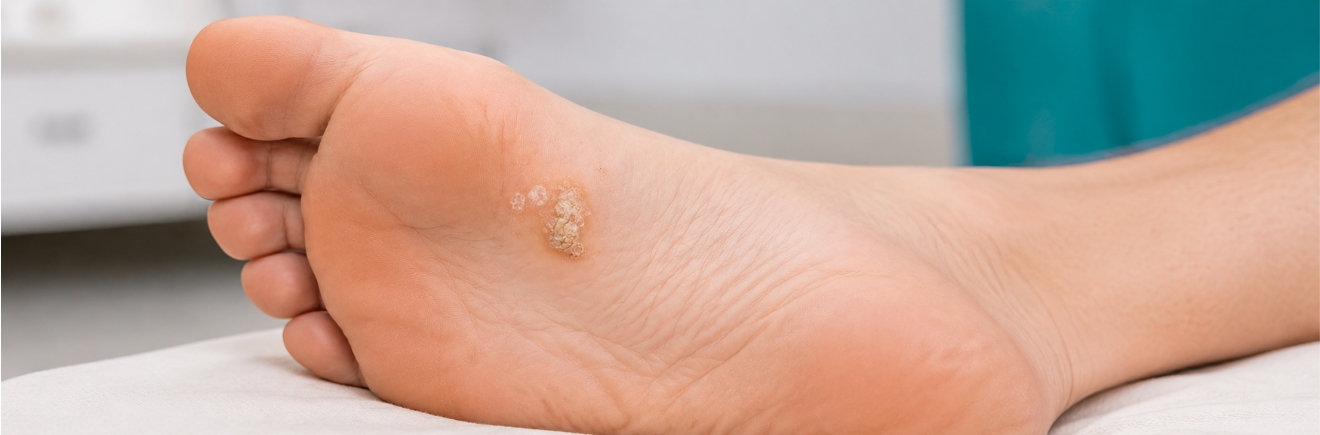
A plantar papilloma is a skin infection caused by the human papillomavirus (HPV) that appears on the sole of the foot as a hyperkeratotic lesion, often mistaken for calluses. It can present as an isolated lesion or cluster together to form mosaic warts.
This is a common pathology, especially in children, adolescents, and people who use shared damp spaces such as swimming pools, gyms, or locker rooms. Early treatment is important to prevent the spread of the lesion, contagion, and increased pain when walking.
At Pie Vital, we perform a clinical diagnosis to differentiate the papilloma from other lesions and select the most appropriate treatment based on the evolution, the number of lesions, and the patient’s response.
Differential diagnosis
We evaluate the lesion to differentiate papillomas from calluses, corns, or other skin alterations through specific clinical examination.
Personalized treatment
We select the treatment based on the type of lesion, its location, the number of warts, and the immune system's response.
Prevention of contagion
We provide measures to prevent the spread of the lesion and reduce the risk of reinfection or transmission.
Clinical approach to plantar papilloma
The treatment of plantar papilloma aims to eliminate the visible lesion and control its evolution, as the virus can remain in the skin. There are different therapeutic options, from topical and chemical treatments to instrumental techniques, selected according to each case.
- Clinical diagnosis of papilloma
- Chemical and physical treatments
- Evolution monitoring
- Measures to prevent contagion
Frequently asked questions
We answer your questions about plantar papillomas
What is a plantar papilloma?
A plantar papilloma is a skin lesion caused by the human papillomavirus that appears on the sole of the foot. It is characterized by a thickened area of skin that can be mistaken for a callus, although it usually features dark spots inside.
How is plantar papilloma spread?
Contagion occurs through direct contact with the virus, especially in damp environments such as swimming pools, showers, or locker rooms. The presence of small lesions on the skin facilitates the entry of the virus.
How to tell a papilloma apart from a callus?
A papilloma usually hurts more when pinched than under direct pressure and may show internal dark spots. Additionally, it alters the natural lines of the skin, which allows for clinical differentiation.
Is it always necessary to treat a plantar papilloma?
Although some lesions may disappear over time, early treatment is recommended to prevent spread, contagion, and increased pain.
What treatments are available for plantar papilloma?
There are different options such as chemical treatments, cryotherapy, or other instrumental techniques. The choice depends on the type of lesion, its location, and the patient’s response.
Does the treatment eliminate the virus?
The treatment eliminates the visible lesion, but the virus can remain in the skin. For this reason, follow-up and preventive measures are important.
Can a papilloma reappear?
Yes, it can reappear or show up in other areas if the virus remains active or if a new infection occurs. Follow-up and prevention help reduce this risk.
How can plantar papilloma be prevented?
It is recommended to wear flip-flops in shared damp spaces, maintain good hygiene, treat foot wounds, and avoid sharing footwear or towels.